Finding Better Products Starts With Better Search Habits
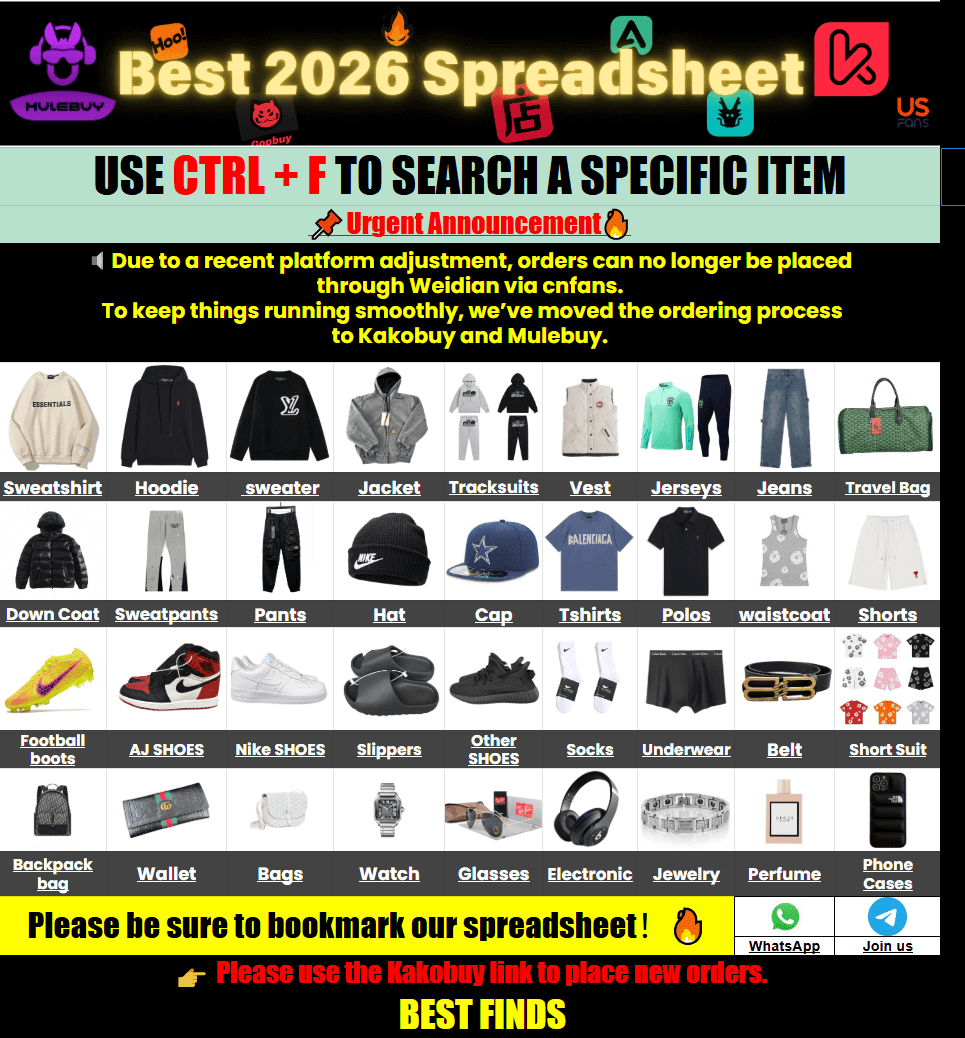
If you are trying to learn how to search filter and find hidden gems on Kakobuy spreadsheet, the biggest challenge is usually not the number of products. It is knowing how to narrow a large product directory without overlooking useful listings. A long spreadsheet can contain plenty of worthwhile finds, but broad searches often return too many unrelated results, while overly specific searches can miss products because sellers use different naming conventions.
A more efficient approach is to treat the spreadsheet like a searchable product catalog. Start with short, meaningful keywords, narrow the results by category or product characteristics, then compare the actual information available on each listing. Once you add QC observations, measurements, price context, and shipping considerations to the process, finding an overlooked item becomes much easier.
For a faster starting point, you can also browse the Kako buy spreadsheet with qc catalog rather than working through a slow, traditional spreadsheet interface.
Smart Search Tip: Looking for more? To find items instantly, use single-word keywords (e.g., “SHOES” or “T-SHIRT”) instead of long sentences for the best results.
Table of Contents
- Finding Better Products Starts With Better Search Habits
- Why Short Search Keywords Usually Work Better
- How to Filter a Large List Without Losing Good Finds
- How to Tell an Interesting Listing From a Weak One
- What QC Photos Can and Cannot Tell You
- Use Measurements Instead of Guessing Size
- A Practical Hidden-Gem Comparison Workflow
- What International Buyers Should Check Before Ordering
- Search Mistakes That Make Good Finds Harder to Spot
- FAQ
Why Short Search Keywords Usually Work Better
One of the easiest mistakes is searching the way you would ask a person a question. A product directory does not necessarily understand a phrase such as “find me a good lightweight black jacket with a relaxed fit.” Sellers may describe essentially the same item using completely different words.
Short keywords create a wider starting pool. Try terms based on the actual product rather than a full description:
- SHOES for broad footwear discovery
- HOODIE for sweatshirt-style products
- JACKET for outerwear
- DENIM for denim-related listings
- CAP for simple headwear searches
- BAG for bags and similar accessories
- JERSEY for sports-inspired tops
After the broad search, refine your thinking rather than immediately adding five or six words to the search box. For example, if “JACKET” produces a useful group of listings, you can then inspect material appearance, construction, measurements, seasonality, and available QC information.
This approach is particularly useful when a hidden gem is not described with the same terminology you expected. Search first for the product family, then identify the characteristics that separate the listings.
How to Filter a Large List Without Losing Good Finds
Filtering should reduce noise without becoming so restrictive that useful products disappear. A practical filter sequence is:
- Start with the broad product category.
- Remove clearly irrelevant product types.
- Compare visible product information.
- Check whether QC photos or useful inspection details are available.
- Compare measurements or specifications.
- Shortlist only the products worth deeper review.
Do not assume the cheapest listing is automatically the best discovery. Price is only one variable. A lower-priced product may have less useful information, fewer inspection details, different dimensions, or construction that does not match what you are looking for.
Likewise, a product with a polished thumbnail should not automatically receive a higher ranking. Promotional images can hide important details that become visible only when you examine additional product information or QC photos.
| Filter Stage | What to Look For | Purpose |
|---|---|---|
| Keyword | Short product-specific term | Build a useful initial result set |
| Category | Correct product type | Remove unrelated listings |
| Specifications | Measurements, weight, dimensions | Compare products objectively |
| QC information | Visible construction and finish | Identify issues before ordering |
| Cost context | Product price plus potential shipping | Avoid judging value from item price alone |
The goal is not to create the smallest possible result list. It is to create a shortlist where every remaining product deserves attention.
How to Tell an Interesting Listing From a Weak One
A genuinely interesting listing usually gives you enough information to make a reasonable comparison. Look for several independent signals rather than relying on a single attractive photo or low price.
Look at the product information first
Check whether the listing provides useful dimensions, product variations, material descriptions, color options, weight, or other measurable specifications. More information does not automatically mean higher quality, but it gives you more ways to evaluate the product.
Compare the actual design details
For clothing, examine the overall silhouette, seams, collar or cuff construction, graphics, pockets, zippers, and hardware where applicable. For footwear, look at the sole shape, upper construction, stitching, symmetry, and visible finishing details. For bags and accessories, pay attention to hardware, edges, attachment points, and alignment.
A hidden gem often becomes interesting because several small details line up: useful specifications, clear photos, sensible dimensions, and a price that remains reasonable after considering the rest of the purchase.
Check variation information
Color and size variations can matter more than they initially appear. A listing may look appealing in one product image but have limited options in the variation menu. Before shortlisting it, confirm that the specific size, color, or configuration you want is actually offered.
What QC Photos Can and Cannot Tell You
QC photos are useful because they provide a more practical view of the physical item than a polished listing image. They can help you inspect visible characteristics such as stitching, graphic placement, color consistency, symmetry, shape, labels, hardware, zippers, and obvious surface defects.
They should not be treated as laboratory evidence. A photograph cannot reliably prove fabric composition, long-term durability, chemical composition, future comfort, or performance after months of use. Lighting and camera angles can also change how colors and textures appear.
A useful QC review is therefore selective. Instead of staring at every pixel, identify the details that matter for the product category.
- Clothing: inspect seams, print alignment, collar shape, labels, visible fabric appearance, and measurements.
- Shoes: check symmetry, sole construction, stitching, visible glue marks, shape, and surface finishing.
- Bags: inspect zippers, hardware, edges, straps, stitching, and alignment.
- Headwear: examine structure, panel alignment, embroidery or graphics, and visible finishing.
If the photos leave an important question unanswered, treat that as uncertainty rather than assuming the product passes the check.
Use Measurements Instead of Guessing Size
Size labels are not standardized enough to be your only reference when comparing products from different manufacturers. A medium in one listing may have very different dimensions from a medium in another.
For clothing, useful measurements can include chest width, shoulder width, garment length, sleeve length, waist, and hip measurements. For footwear, foot length and insole length are more useful than simply selecting your normal US, UK, or EU size.
A simple comparison method is to take a garment you already own that fits well and compare its measurements with the seller-provided dimensions. The same principle applies to shoes: measure your foot and compare that measurement with the available sizing information.
When a listing has several size options, record the actual dimensions rather than relying on S, M, L, or XL. This turns an uncertain size decision into a measurable comparison.
A Practical Hidden-Gem Comparison Workflow
Once you have a manageable set of results, resist the temptation to open everything at once. A shortlisting system is faster.
1. Create a five-item shortlist
Choose a handful of products that immediately appear relevant. At this stage, you are not deciding what to buy. You are deciding what deserves further inspection.
2. Remove listings with obvious gaps
If a product lacks the specifications you need, has unclear variations, or shows visible problems in available imagery, move it down the list. Do not spend ten minutes researching a listing that already fails your basic requirements.
3. Compare the strongest three
For the remaining products, compare measurable details, appearance, available QC information, size options, and total purchase considerations. A simple decision framework can look like this:
| Criterion | Strong Signal | Warning Sign |
|---|---|---|
| Product information | Clear specifications and variations | Important details missing |
| QC photos | Useful angles and visible details | Critical areas cannot be inspected |
| Measurements | Specific dimensions available | Only generic size labels |
| Construction | Consistent stitching and alignment | Visible asymmetry or finishing issues |
| Value | Reasonable overall purchase cost | Low item price but unclear total cost |
If you want to continue browsing by product grouping, the Kakobuy Spreadsheet Sets section can be useful for comparing coordinated product combinations rather than isolated listings.
What International Buyers Should Check Before Ordering
Finding a promising product is only part of the decision for an international buyer. The final cost and delivery experience can depend heavily on destination, parcel dimensions, shipping route, carrier, and the rules of the destination country.
For buyers in the US, UK, EU, Canada, Australia, New Zealand, and other markets, check the current customs and tax guidance applicable to your destination before placing an order. VAT, GST, import treatment, IOSS availability, and DDP or DDU arrangements can vary by destination and shipping method.
Parcel size can also matter. Lightweight products are not necessarily expensive to ship, while bulky products may be affected by volumetric weight. This is particularly relevant when comparing jackets, footwear, bags, or multiple-item orders.
For regulated, restricted, or biosecurity-sensitive products, confirm that the item and chosen shipping route are permitted before ordering. Do not assume that because an item appears in a product directory, every destination or carrier will accept it.
Search Mistakes That Make Good Finds Harder to Spot
Searching with long sentences: This can produce weak results when the catalog uses different product terminology. Start broad and refine manually.
Choosing only by price: A cheap listing is not automatically better value. Compare specifications, visible quality indicators, and expected shipping costs.
Ignoring measurements: Generic size labels can create avoidable mistakes. Actual dimensions provide a stronger basis for comparison.
Overtrusting product photos: Marketing images show presentation, not necessarily every construction detail. Use available QC imagery for a more grounded inspection.
Opening too many listings: A shortlist of strong candidates is easier to compare than dozens of tabs. Eliminate weak options early.
Forgetting the destination: A product that makes sense at item level may become less attractive once shipping, customs, VAT/GST, or package dimensions are considered.
FAQ
Q: What is the fastest way to search a large Kakobuy product list?
A: Start with a single product keyword such as “SHOES,” “JACKET,” or “BAG.” Once you have relevant results, narrow the selection by product details and specifications rather than entering a long sentence.
Q: How do I identify a hidden gem rather than just a cheap listing?
A: Look for a combination of useful product information, sensible measurements, suitable variations, clear inspection photos, and acceptable visible construction. Price should be considered alongside these factors.
Q: Can QC photos confirm product quality completely?
A: No. QC photos can reveal visible details such as stitching, alignment, shape, labels, and obvious defects, but they cannot reliably establish long-term durability, exact material composition, or future comfort.
Q: Should I use my usual clothing size?
A: Not automatically. Compare seller-provided dimensions with measurements from a garment that already fits you well. Manufacturer sizing can vary substantially between products.
Q: Is a product with more QC photos always better?
A: Not necessarily. Photo count matters less than whether the images show the areas you actually need to inspect. A few useful angles can be more informative than many repetitive photographs.
Q: Should international buyers check shipping before choosing a product?
A: Yes. Shipping method, parcel size, destination rules, taxes, and carrier restrictions can change the overall value of a product. Check the current requirements for your country before ordering.
Turn Browsing Into a Shortlist, Not a Scavenger Hunt
The most effective way to uncover overlooked products is not to search harder; it is to search more deliberately. Use short keywords to discover the broad product pool, filter out obvious mismatches, then compare specifications, measurements, QC information, and total purchase considerations.
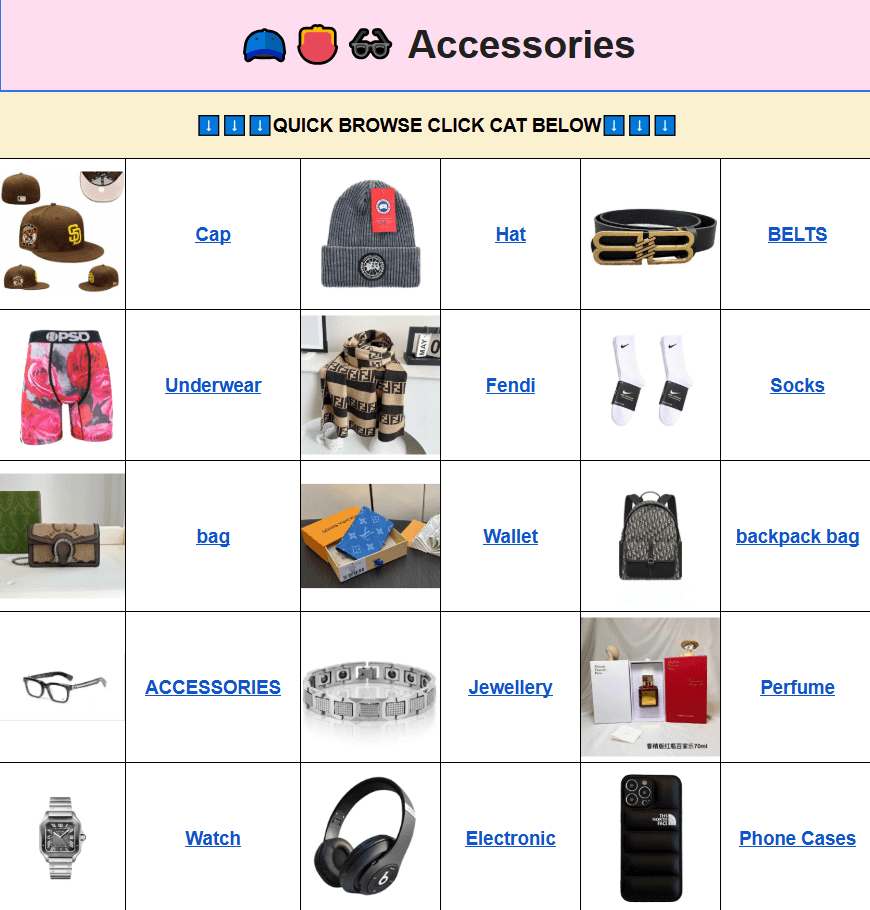
That workflow also makes the catalog easier to use on a phone or desktop because you are no longer trying to inspect every listing. The objective is to move from hundreds of possible results to a small group of products that have enough information to justify a closer look.
For international shoppers, the final decision should combine product fit, measurable specifications, visible QC details, and destination-specific purchasing considerations. That is where a basic spreadsheet search becomes a much more useful sourcing process.