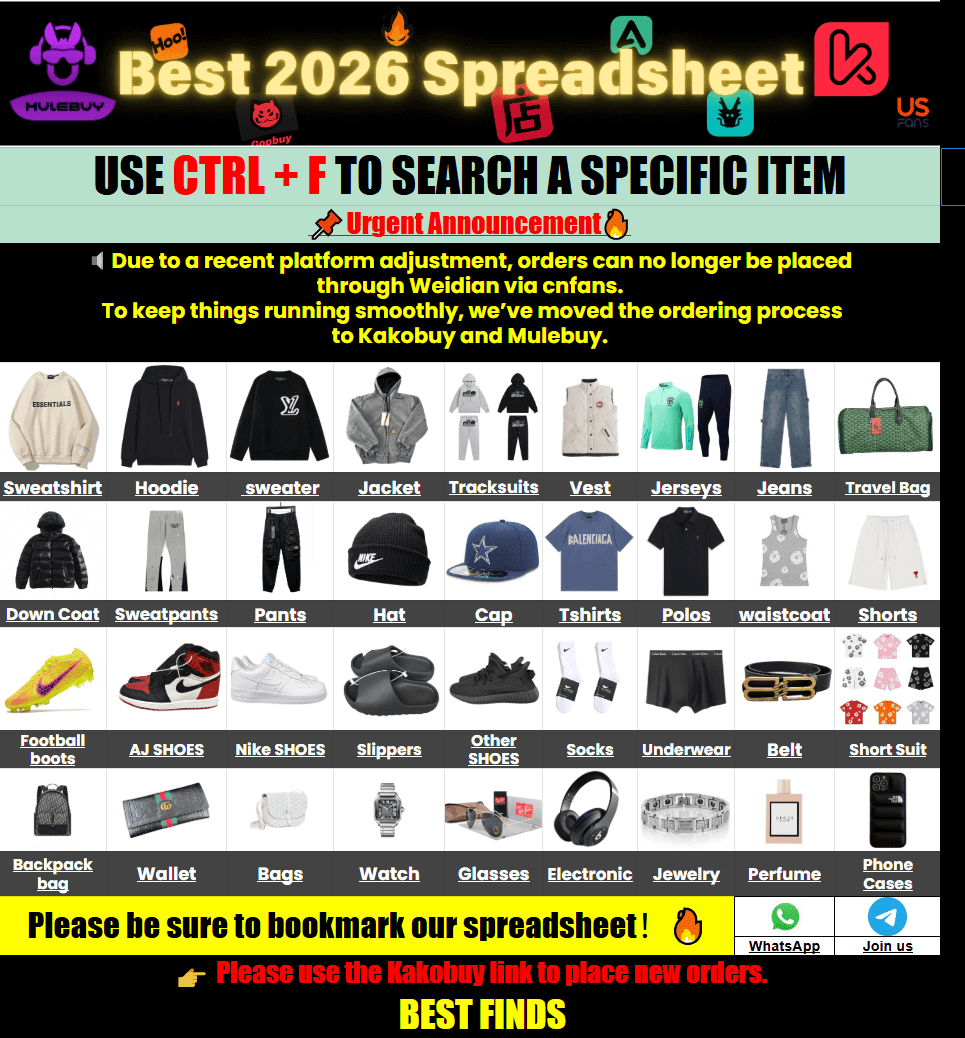
Mobile users often face the same frustrating problem: a large product spreadsheet loads slowly, scrolling becomes awkward, and finding one useful listing takes far longer than it should. A Kakobuy spreadsheet website provides a more practical way to browse this type of sourcing information by presenting spreadsheet-based product data through a faster, catalog-style interface. Instead of repeatedly zooming, scrolling, and waiting for a large sheet to respond, shoppers can use categories, product pages, search tools, and direct sourcing links to narrow down what they actually want.
The goal is not simply to make a spreadsheet look nicer. A well-organized web catalog changes how you search, compare, inspect, and eventually move to an external shopping platform.
Smart Search Tip: Looking for more? To find items instantly, use single-word keywords (e.g., “SHOES” or “T-SHIRT”) instead of long sentences for the best results.
- Why Large Product Spreadsheets Lag on Mobile
- What Changes on a Web-Based Catalog?
- A Faster Mobile Search Workflow
- How to Evaluate a Listing Before Clicking Through
- What QC Details Can You Actually Check on a Phone?
- Do Not Let a Fast Interface Hide the Measurements
- What International Shoppers Should Check Before Ordering
- Mobile Browsing FAQ
- A Better Way to Browse on a Small Screen
Why Large Product Spreadsheets Lag on Mobile
Google Sheets is useful for organizing thousands of rows, but it is not always the most comfortable interface for product discovery on a phone. A sourcing sheet may contain long URLs, multiple columns, images, formulas, filters, notes, supplier information, and large amounts of historical data. On a desktop connection, that may be manageable. On a mobile browser, it can become a very different experience.
Typical symptoms include delayed scrolling, columns that are difficult to read, accidental horizontal movement, slow filtering, and repeated zooming. A shopper may know exactly what they want but still spend several minutes locating the relevant row.
There is also a cognitive problem. Spreadsheet layouts are designed around structured data rather than visual product discovery. You are often comparing cells instead of looking at products.
A web catalog addresses that problem by separating discovery from raw data management. Categories can group related products, individual pages can present the available information in a more readable format, and external sourcing links can remain available when you decide to proceed.
What Changes on a Web-Based Catalog?
The biggest difference is the unit you interact with. In a spreadsheet, the basic unit is the row. In a catalog, the basic unit is the product listing.
That distinction matters when browsing from a phone. A product-oriented layout can surface the information you need without requiring you to interpret an entire row across several columns.
| Browsing method | Typical mobile challenge | More practical approach |
|---|---|---|
| Large spreadsheet | Horizontal scrolling and dense rows | Use it as a source database when detailed row information is needed |
| Web catalog | Individual pages may contain different levels of detail | Use categories and search to discover products quickly |
| Product detail page | Information can still require careful interpretation | Review images, measurements, descriptions, and sourcing information together |
| External shopping platform | Different interface and purchasing workflow | Move there only after deciding which listing is worth investigating |
This does not mean the original spreadsheet becomes useless. It can remain valuable as a large reference database. The web catalog simply creates a more convenient discovery layer for users who do not want to manipulate a huge sheet on a small screen.
For broader browsing, the Kako buy spreadsheet resource can be used as the main entry point before narrowing down to individual product pages.
A Faster Mobile Search Workflow
Mobile shopping becomes much quicker when you stop treating the catalog like a document that needs to be read from top to bottom. Instead, treat it as a searchable index.
1. Start with the product type
Think in short, recognizable terms. If you want footwear, try “SHOES.” If you are looking for a particular garment, use the relevant product type rather than writing a full natural-language sentence.
This is especially useful when the catalog contains thousands of entries. Short search terms reduce the amount of irrelevant information you need to process.
2. Narrow by category before deep inspection
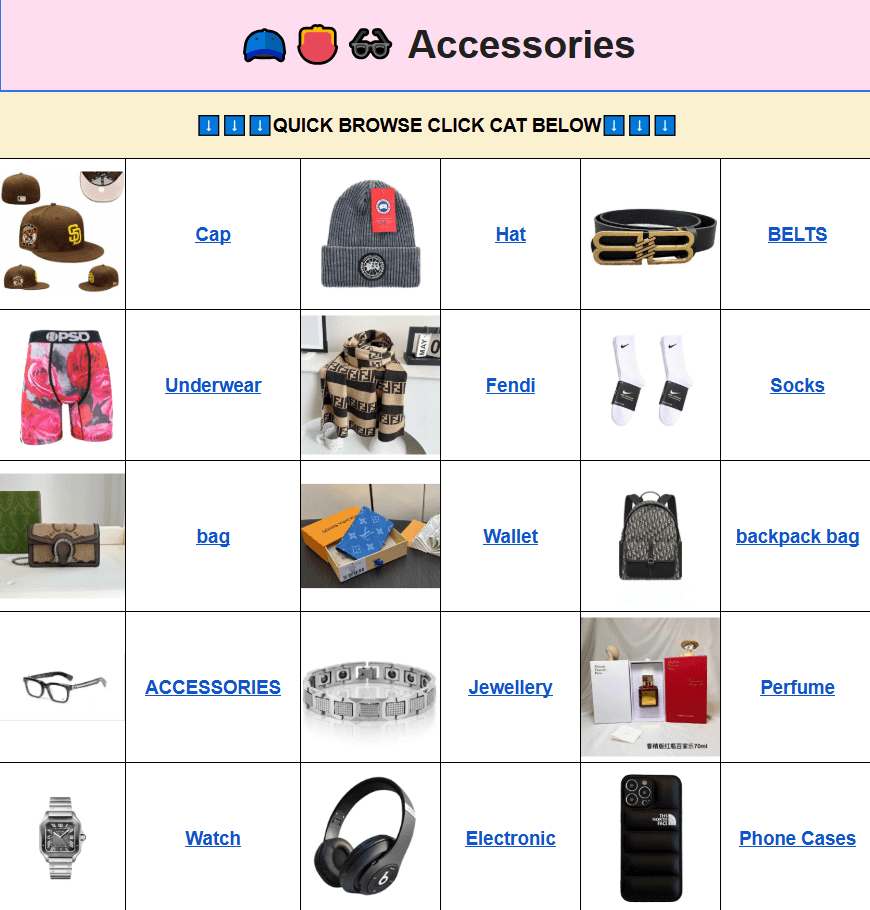
Category navigation is useful when you already know the general product class. It removes unrelated listings before you start comparing individual items.
For example, shoppers interested in coordinated clothing can browse the Kako buy Spreadsheet Sets category instead of searching across every clothing listing.
3. Open only promising listings
Do not open ten product pages just because they appear near each other in a search result. Look first at the thumbnail, title, available information, and any visible sourcing details. Open the listings that appear relevant, then compare them more carefully.
4. Save the useful information before leaving
If a product looks promising, record the important details before moving to another page. Depending on the listing, that could include the source link, seller-provided measurements, color option, size information, or notes that affect the eventual purchase.
This workflow reduces the number of pages your phone needs to load and, more importantly, reduces unnecessary decision-making.
How to Evaluate a Listing Before Clicking Through
A faster catalog is only useful if you do not sacrifice product evaluation. Speed should reduce browsing friction, not encourage rushed purchases.
Before following an external sourcing link, check whether the listing gives you enough information to justify further research.
- Product identity: Is the item clearly described, or is the title too vague to distinguish it from similar listings?
- Images: Are there enough views to understand the shape, construction, and major visible details?
- Specifications: Are dimensions or other measurable details available?
- Variants: Are colors, sizes, or configurations clearly identified?
- Source information: Is the original marketplace or sourcing link available?
- QC material: If photographs are provided, do they show useful areas rather than only promotional angles?
One useful rule is to distinguish discovery information from verification information. A thumbnail may help you discover an item. It does not automatically verify material quality, durability, long-term comfort, or construction performance.
The same principle applies to QC photographs. Images can reveal visible stitching issues, uneven graphics, color differences, shape problems, damaged hardware, or obvious defects. They cannot establish everything about how a product will perform after months of use.
What QC Details Can You Actually Check on a Phone?
QC review on a mobile screen is possible, but screen size changes how carefully you should interpret photographs. Zooming into a picture can reveal a loose thread or uneven print, but excessive digital zoom can also make normal image compression look like a defect.
Focus on details that photographs can reasonably show:
- Whether major seams appear straight and consistently stitched.
- Whether visible graphics or prints appear reasonably aligned.
- Whether colors look consistent across different photographed sections.
- Whether the overall shape appears symmetrical.
- Whether zippers, buttons, buckles, or other hardware look visibly damaged.
- Whether shoes show obvious differences between left and right sides.
- Whether labels, tags, or packaging appear damaged when those details matter to you.
For footwear, pay particular attention to the sole structure, toe shape, visible glue marks, panel alignment, and symmetry. For clothing, inspect collars, cuffs, seams, graphics, and the overall silhouette.
A useful mobile habit is to compare several photographs rather than judging the item from one close-up. A defect that appears significant in one image may look different when you understand the product’s full shape.
Do Not Let a Fast Interface Hide the Measurements
One of the easiest mistakes to make when shopping quickly is relying on familiar size labels. S, M, L, and XL do not represent a universal physical measurement. Different manufacturers can use different grading systems, and similar-looking garments can have substantially different proportions.
Where available, compare actual dimensions with an item you already own.
| Product type | Useful measurements | What to compare |
|---|---|---|
| Tops | Chest width, shoulder width, garment length, sleeve length | Compare with a well-fitting garment measured flat |
| Pants | Waist, hip, rise, inseam, leg opening | Compare against your own trousers rather than only the size label |
| Shoes | Foot length, insole length, width where available | Check the manufacturer’s dimensions and your actual foot measurement |
| Accessories | Length, circumference, width, product weight | Check whether the physical dimensions suit your intended use |
Measurement comparison is particularly important for international shoppers because US, UK, EU, Australian, and other sizing conventions do not always translate neatly between manufacturers. Even when a conversion chart is displayed, manufacturer dimensions are usually the more useful reference.
What International Shoppers Should Check Before Ordering
The web catalog is primarily a discovery and sourcing-information layer. When you decide to purchase, the transaction is completed through the relevant external shopping platform. That means the final purchasing conditions can depend on the destination, selected service, seller, and shipping route.
For buyers outside China, check these points before submitting an order:
- Destination eligibility: Confirm that the selected shopping service ships to your country or region.
- Shipping method: Compare the available routes rather than assuming the cheapest option is the best fit.
- Package characteristics: Weight and dimensions can influence international shipping calculations, including possible volumetric-weight treatment.
- Customs: Import procedures and charges vary by destination. Check current guidance for your country.
- VAT or GST: UK, EU, Australia, New Zealand, and other markets can apply different tax and collection mechanisms.
- DDP or DDU: Understand whether applicable import charges are handled during checkout or may be collected later.
- Restricted goods: Certain products, materials, batteries, liquids, food-related items, or other categories can face transport restrictions.
Do not treat a fast mobile interface as a shortcut around these responsibilities. The catalog helps you find and compare products; the external ordering platform and destination authorities determine the applicable purchasing, shipping, and import conditions.
Mobile Browsing FAQ
Q: Why does a large product spreadsheet feel slow on my phone?
A: Large sheets can contain many rows, formulas, links, images, and columns. Mobile browsers also have less screen space and different rendering constraints, making dense spreadsheets harder to navigate efficiently.
Q: Is a web catalog better than a spreadsheet for every task?
A: Not necessarily. A spreadsheet can be useful for detailed database-style reference work, while a catalog is generally more convenient for visual discovery, category browsing, and opening individual product information.
Q: Can I do QC review on a phone?
A: Yes. You can inspect visible construction, graphics, symmetry, color consistency, hardware, and obvious defects. However, photographs cannot prove properties such as long-term durability or exact material composition.
Q: What should I search for if I want results quickly?
A: Use short product-type keywords such as “SHOES,” “T-SHIRT,” or another distinctive single-word term. This usually creates a cleaner starting point than entering a long sentence.
Q: Should I trust S, M, L, or XL sizing labels?
A: Treat them as secondary information. Seller or manufacturer measurements are more useful because sizing systems vary. Compare chest, waist, length, foot length, or other relevant dimensions with something you already own.
Q: Does faster browsing mean faster international delivery?
A: No. Website performance and shipping performance are separate issues. Once you move to an external shopping platform, delivery time depends on the seller, warehouse processing, selected carrier, route, customs, and destination.
A Better Way to Browse on a Small Screen
The practical fix for mobile spreadsheet frustration is not simply waiting for a large sheet to finish loading. It is changing the browsing workflow.
Use a web-based catalog for discovery, search with short product terms, narrow results through categories, and open only the listings worth closer inspection. Once you find a promising item, slow down for the parts that actually matter: photographs, dimensions, variants, sourcing information, and destination-specific ordering conditions.
That combination gives mobile shoppers a better balance between speed and careful evaluation. The objective is not to remove every step from sourcing. It is to eliminate the unnecessary scrolling, waiting, and searching that makes a large product spreadsheet difficult to use in the first place.